Reducing production pressure on natural resources, a necessary commitment in cosmetic natural ingredient sourcing
Behind every natural cosmetic ingredient lies a plant, a landscape, and the women and men who harvest and process it.
Preserving biodiversity also means ensuring that the commercial success of a botanical ingredient does not place excessive pressure on the ecosystems that sustain it.
The history of argan oil offers a particularly revealing example of this challenge.
Argan Oil: When Global Success Meets the Limits of a Natural Resource
Over the past few decades, argan oil has become an iconic ingredient in natural cosmetics and premium food products. Its unique composition, traditional production methods and Moroccan origins have contributed to its international recognition.
However, the growing popularity of an ingredient does not necessarily mean that its natural production capacity can increase at the same pace.
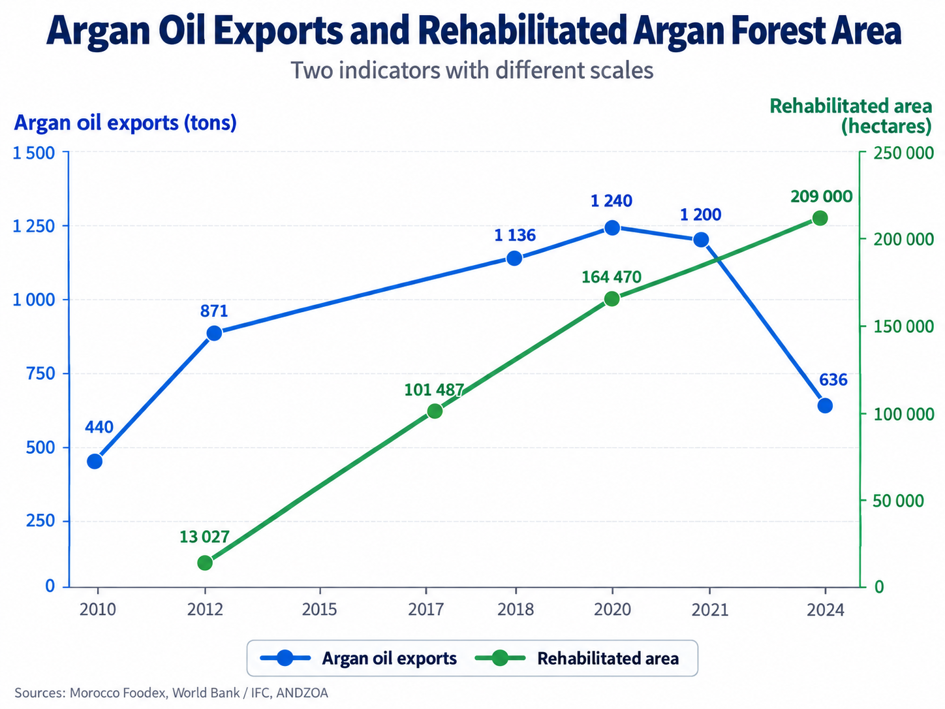
After decades of international expansion, Moroccan argan oil exports have declined significantly in recent years. This decline does not necessarily indicate a loss of consumer interest. It also reflects the consequences of prolonged drought, reduced fruit availability, higher raw material costs and changes in the organisation of the export sector.
Argan remains a geographically concentrated resource.
The Arganeraie Biosphere Reserve, recognised by UNESCO in 1998, extends across approximately 2.5 million hectares, while argan forests themselves cover around 830,000 hectares.
Scientific research has documented a substantial historical decline in forest density, from approximately 100 to fewer than 30 argan trees per hectare in affected areas, highlighting the long-term vulnerability of this remarkable ecosystem.
Morocco has launched major restoration programmes to protect this natural heritage. According to ANDZOA, more than 176,000 hectares of argan forests have been rehabilitated, with national ambitions to reach approximately 400,000 hectares by 2030.
However, restoring forest ecosystems does not automatically translate into increased oil production. Ecological regeneration requires time, appropriate management and sustainable harvesting practices.
The Hidden Risks of Commercial Success
When demand and harvesting pressure exceed an ecosystem’s capacity to regenerate, several risks emerge: premature fruit harvesting, overgrazing, insufficient natural regeneration, increasing pressure on cooperatives and greater exposure to raw material adulteration.
Climate change adds another major challenge, particularly in regions already experiencing recurring droughts.
A botanical resource under excessive pressure can progressively lose its ecological resilience, compromise supply consistency and weaken the credibility of the entire value chain.
This raises an important question for the cosmetic industry:
Should we continuously increase production from the same botanical resources, or should we also diversify our sourcing territories and ingredients?
At SAHARÔME, we believe responsible sourcing requires both approaches to be carefully balanced.
SAHARÔME: Two Practical Commitments to Responsible Sourcing
1. Developing Sourcing in Less Commercially Concentrated Territories
Our first commitment is to diversify sourcing within the existing geographical range of argan trees.
SAHARÔME focuses particularly on the argan-producing landscapes of Guelmim-Oued Noun, in southern Morocco, where official regional statistics recorded 147,764 hectares of argan woodland in 2019.
Developing structured, traceable sourcing partnerships in this region offers an opportunity to support rural communities, diversify supply networks and encourage responsible management of local argan resources.
Our objective is not simply to source more argan oil, but to source it differently.
However, geographical diversification alone is not enough.
Responsible production must also consider fruit availability, harvesting practices, traceability and the long-term regeneration of the resource.
Our objective is not simply to source more argan oil, but to source it differently.
2. Offering Cosmetic Formulators a Wider Diversity of Botanical Oils
Our second commitment is to explore complementary African botanical oils that can provide formulators with valuable alternatives while reducing excessive dependence on a limited number of highly commercialised ingredients.
Baobab seed oil (Adansonia digitata) is a particularly promising example.
Its fatty acid composition shares several characteristics with argan kernel oil, particularly the presence of oleic and linoleic acids, while retaining its own distinctive identity, including a generally more pronounced natural colour and a subtle characteristic odour.
Rather than considering these oils interchangeable, we see them as complementary botanical ingredients, each offering specific formulation opportunities.
Starting in December 2026, SAHARÔME will begin developing a traceable baobab oil value chain in the relatively preserved landscapes of northern Benin.
This initiative aims to create new opportunities for local producers while promoting the sustainable use of African botanical resources.
Our approach also relies on understanding and documenting the characteristics of each vegetable oil, allowing us to highlight its specific qualities and provideformulators with reliable information for selecting the most suitable ingredients for their cosmetic applications.
A COSMOS APPROVED application is also planned for this new baobab oil.
Baobab Seed Oil: Genuine Cosmetic Benefits
Beyond its sourcing potential, baobab seed oil offers valuable functional properties for cosmetic formulations, particularly those designed for dry and fragile skin.
Its rich fatty acid composition contributes to softening and nourishing the skin while helping maintain its natural moisture balance.
A scientific pilot study published in 2017 by Komane and colleagues, involving 20 adult female volunteers, investigated the effects of baobab seed oil on skin hydration, water loss and tolerance.
The results showed a reduction in transepidermal water loss following topical application of baobab oil, suggesting that it may help support the skin’s natural barrier against moisture loss.
The study also reported good skin tolerance under the tested conditions.
Although these preliminary findings require confirmation through larger studies, they provide useful scientific support for the cosmetic interest of baobab seed oil.
These properties are consistent with its composition, which includes oleic, linoleic and palmitic fatty acids, alongside naturally occurring minor components such as phytosterols and tocopherols.
Baobab oil offers a wide range of formulation opportunities, including facial oils and serums for dry skin, nourishing body balms, lip care, solid cosmetics, and hair oils or masks for dry and textured hair.
Its versatility makes it particularly interesting for formulators seeking botanical ingredients that combine natural origin, sensory qualities and skin-conditioning benefits.
Diversifying to Preserve Biodiversity
Baobab oil is not intended to replace argan oil. It expands the range of botanical possibilities available to cosmetic formulators.
Argan remains a remarkable ingredient with a unique composition, heritage and geographical identity. Its sustainable future depends on protecting the ecosystems and communities that have preserved it for generations.
At the same time, Africa offers an extraordinary diversity of botanical resources whose potential remains insufficiently explored and valued.
Developing these resources responsibly means creating opportunities without simply transferring excessive production pressure from one ecosystem to another.
For SAHARÔME, responsible sourcing is about anticipating the ecological consequences of an ingredient’s commercial success, distributing sourcing opportunities across different territories and building sustainable value chains rooted in Africa’s botanical diversity.
Because protecting biodiversity is not only about preserving what already exists.
It is also about making better choices regarding what we source, where we source it and how we develop it.
Interested in learning more about our African botanical oils and responsible sourcing initiatives? Contact us!
Scientific and institutional references
- UNESCO — Arganeraie Biosphere Reserve, designated in 1998.
- Moroccan Ministry of Agriculture / FIFARGANE — Argan Sector Development Programme 2021–2030.
- Morocco Foodex / World Bank–IFC — Argan oil export trends and sector development.
- Komane, B. M., Vermaak, I., Kamatou, G. P. P., Summers, B. & Viljoen, A. M. (2017). Beauty in Baobab: A pilot study of the safety and efficacy of Adansonia digitata seed oil. Revista Brasileira de Farmacognosia, 27(1), 1–8. DOI: 10.1016/j.bjp.2016.07.001.